


Controlled Transmission of a Fijivirus Under Field Conditions Using Mass-Reared Planthoppers
利用规模化饲养飞虱在田间条件下实现 Fijivirus 的可控传播方法

发布: 2026年03月20日第16卷第6期 DOI: 10.21769/BioProtoc.5642 浏览次数: 49
评审: Nelson Bernardi LimaAnonymous reviewer(s)
 PDF
PDF  Q&A
Q&A
Advertisement







Abstract
Mal de Río Cuarto disease, caused by a Fijivirus, is a major constraint for maize production in Argentina. The traditional evaluation of resistant hybrids is limited by the low efficiency of natural virus transmission and the lack of standardized field inoculation methods. We developed a protocol that combines laboratory mass-rearing of the planthopper vector Delphacodes kuscheli with a controlled field transmission system. The method involves the synchronized production of large insect populations, acquisition of viruliferous vectors under controlled conditions, and their safe transport to the field using specialized containers. Transmission is achieved through individual cages placed on maize seedlings, ensuring high inoculation pressure under field-like conditions. This protocol enables reliable and reproducible virus transmission, facilitating large-scale screening of maize hybrids and other cereals. Its main advantages are the high throughput of vector production, improved transmission efficiency, and adaptability to diverse experimental designs.
Key features
• Requires prior knowledge of the target planthopper vector's life cycle for successful rearing and colony maintenance.
• Generates a high-throughput output of over 400 insects per rearing cage, ensuring sufficient vector availability for large-scale transmission assays.
• Field transmission assays conducted under field-like conditions (soil, temperature, and humidity) combined with directed, high-pressure inoculation.
• Optimized for efficient Fijivirus transmission, including management of the viral latency period and maximization of transmission efficiency.
Keywords: Maize (玉米) Mal de Río Cuarto (Mal de Río Cuarto)
Planthoppers (飞虱)
Field transmission (田间传播)
Delphacodes kuscheli (Delphacodes kuscheli)
Fijivirus (Fijivirus)
Insect mass-rearing (昆虫规模化饲养)
Host resistance (寄主抗性)
Mal de Río Cuarto (Mal de Río Cuarto)
Planthoppers (飞虱)
Field transmission (田间传播)
Delphacodes kuscheli (Delphacodes kuscheli)
Fijivirus (Fijivirus)
Insect mass-rearing (昆虫规模化饲养)
Host resistance (寄主抗性)
Background
Mal de Río Cuarto is endemic to Argentina and is the most significant viral disease affecting maize crops [1–2]. As a result of infection, producers suffer substantial economic losses, such as those observed during the 2020/21 season, with incidences reaching 83% in the endemic area (province of Córdoba, Argentina) [3]. In this context, seed companies are making substantial efforts to develop maize hybrids that show improved resistance to the virus, aiming to reduce or prevent production losses.
The main challenge in identifying tolerant or resistant hybrids lies in the fact that the causal agent, mal de Río Cuarto virus (MRCV, Spinareoviridae: Fijivirus), is transmitted exclusively by insect vectors of the family Delphacidae in a persistent and propagative manner [4,5]. This requires a latency period between virus acquisition and the ability to transmit [6]. Another critical issue is the low probability of transmission under natural conditions [7] because the main vector, Delphacodes kuscheli Fennah, does not prefer maize as a host [8] and cannot complete its life cycle on this crop [9]. High insect mortality during the latency period, combined with low transmission efficiency under experimental and natural conditions, necessitates large insect populations to perform transmission assays for both maintaining plant inoculum and evaluating maize hybrids [10].
Previous studies on MRCV have described methodologies for rearing D. kuscheli and multiplying viral inoculum using wheat plants [5,10]. However, no standardized methods for conducting MRCV transmission assays under field conditions have been documented. Although studies on other maize viruses exist [11], their approaches are not applicable to the MRCV–maize–D. kuscheli pathosystem. This work focuses on developing a methodology for mass rearing D. kuscheli to obtain large insect populations in limited space and on establishing a suitable protocol for field experiments, such as evaluating maize materials for MRCV resistance. Notably, this methodology is also suitable for winter cereal trials.
Compared with previously described methods, our protocol offers significant advantages. The rearing and transmission cages are cost-effective and easy to manufacture, reducing operational complexity. The mass-rearing system allows a greater number of adults to be placed for oviposition than in earlier methodologies, producing 400–500 nymphs per cage and reducing maintenance time because host plants deteriorate less and nymphs are transferred at more advanced, less fragile stages, minimizing mortality associated with mouth aspirator handling [10]. During transport to the field, insect mortality is minimal, and transfer to maize plants is rapid and efficient using individual cages secured with stakes, preventing losses due to storms. Unlike other protocols that are not applicable to D. kuscheli due to its lack of maize preference [11], our method ensures vector confinement, increasing inoculation pressure and achieving transmission efficiencies (expressed as disease incidence) of up to 57.3% in susceptible genotypes, demonstrating the robustness of the protocol (see Validation of the protocol section and Table 1), which is comparable to those obtained in wheat under controlled conditions [12–14]. As a limitation, the protocol requires specific infrastructure and trained personnel for vector life cycle management. Beyond maize, this methodology can be adapted for winter cereal trials, broadening its experimental applicability.
Materials and reagents
Biological materials
1. Insect vectors (Delphacodes kuscheli Fennah) obtained from a colony reared in the Vector's Laboratory of IPAVE, originally isolated from the MRCV-endemic area (Río Cuarto County, Córdoba Province, Argentina) and maintained since 2008
2. MRCV isolate (Spinareoviridae: Fijivirus) obtained from infected oat plants of the Río Cuarto endemic area and maintained in wheat (Triticum aestivum cv. ProINTA Federal) since 2008 by serial vector transmissions using D. kuscheli
3. Seeds of wheat (Triticum aestivum) and oat (Avena sativa) obtained by the Wheat Group of IPAVE and the Wheat Improvement, Biotechnology and Pathology Group of the INTA EEA Marcos Juárez (Córdoba, Argentina)
4. Maize seedlings and field trials provided by Syngenta Agro S.A
Trials and breeding room supplies
1. Transparent plastic bottles, 6 L (repurposed water containers) for the fabrication of mass rearing cages
Note: Each bottle features openings at both ends and has windows on the sides. Voile fabric covers all openings (except the bottom end) to ensure air circulation and prevent humidity condensation and insect escape. A small hole in the voile at the top end allows insects entry and remains sealed with a cotton plug (Figure 1a).
2. Sifted soil
3. Clear plastic trays (24.5 × 17.5 × 4.5 cm; L × W × H)
4. Fine-mesh white polyester fabric (voile), ~50 mesh (300 μm aperture)
5. Soft rubber hose (approximately 7.5 mm Ø)
6. 1,000 μL universal fit pipette tips (e.g., Corning, catalog number: CLS4868 or similar)
7. Fast-drying universal adhesive for fabric bonding (Uhu® or similar product)
8. Scissors
9. Professional cutter with segmented blade, 25 mm
10. Cotton (as needed)
11. 500 mL reinforced PET bottles (approximately 0.5 mm wall thickness) for transmission cages
Note: These cages feature a cut-out bottom end (Figure 2a) and a voile-covered lateral window to facilitate ventilation and prevent humidity condensation (Figure 2b). The screw cap end serves as an entry point for insects (Figure 2d).
12. Test tubes, 13 × 100 mm (e.g., Pyrex, catalog number: PY-99445-12)
13. Cool box 54 L (69 × 35 × 45 cm; L × W × H) (e.g., Colombraro, catalog number: 4252)
14. Plasticized test tube rack for 24 test tubes, 4 rows × 6 tubes (e.g., Leone, catalog number: LE-7-104)
15. 40 cm long stakes, fabricated from steel wire (2.5 mm Ø)
16. Elastic rubber bands (approximately 50 mm Ø)
17. Cold packs
18. Commercial contact aerosol insecticide (pyrethroid-based, e.g., Raid® Home and Garden) (store at room temperature and verify the expiration date before use to ensure maximum efficacy)
19. LED bulbs (9–13 W, e.g., Philips LED bulbs) in cool-daylight (6,500 K) and warm-white (3,000 K) spectra
20. T8 LED tubes (9 W, 60 cm, e.g., Philips LED tubes) in cool-daylight (6,500 K) and neutral-white (4,000 K) spectra
Equipment
1. Growth room at 23 ± 2 °C with 16/8 h light/dark photoperiod (cool and warm LED lamps and neutral white LED tubes can be used); alternatively, a plant growth chamber (e.g., Conviron or similar) may be used
2. Dehumidifier (Hitachi, model RD-1604LD)
3. Mouth aspirator
Note: This device comprises a soft rubber tube (50–60 cm long × 7.5 mm Ø) fitted with a 1,000 μL pipette tip at each end. A piece of voile fabric between one end of the tube and the pipette tip acts as a mesh barrier, preventing insects from entering the tube (Figures 1a and 3a).
4. Insect manipulation chamber (black acrylic or black-painted wood; approximately 50 × 30 × 30 cm or larger; H × W × D).
Note: The chamber consists of a black box with an open front for manipulation access and a translucent glass panel at the back to allow light transmission (Figure 3b).
5. Bedside lamp with LED light (Figure 3b)
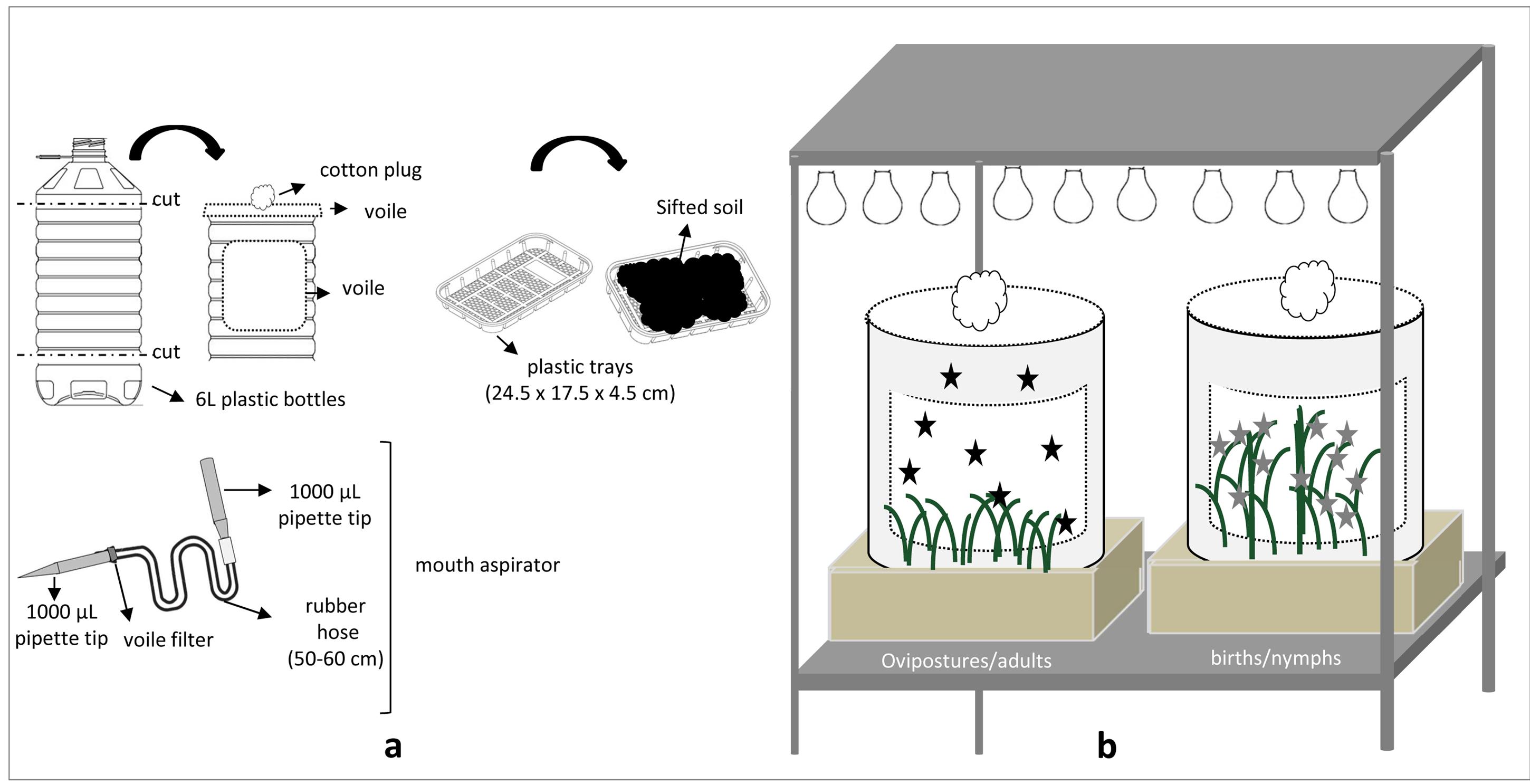
Figure 1. Representative scheme of mass rearing of Delphacodes kuscheli. (a) Supplies for the fabrication of mass rearing cages and mouth aspirator: 6 L plastic containers, fine-mesh voile for ventilation windows, pipette tips, and soft rubber tubing. (b) Rearing cages with oviposition and nymph emergence of D. kuscheli conditioned under LED lighting (16/8 h light/dark photoperiod) to ensure optimal plant and insect growth. (Black stars: adult insects; grey stars: nymphs).
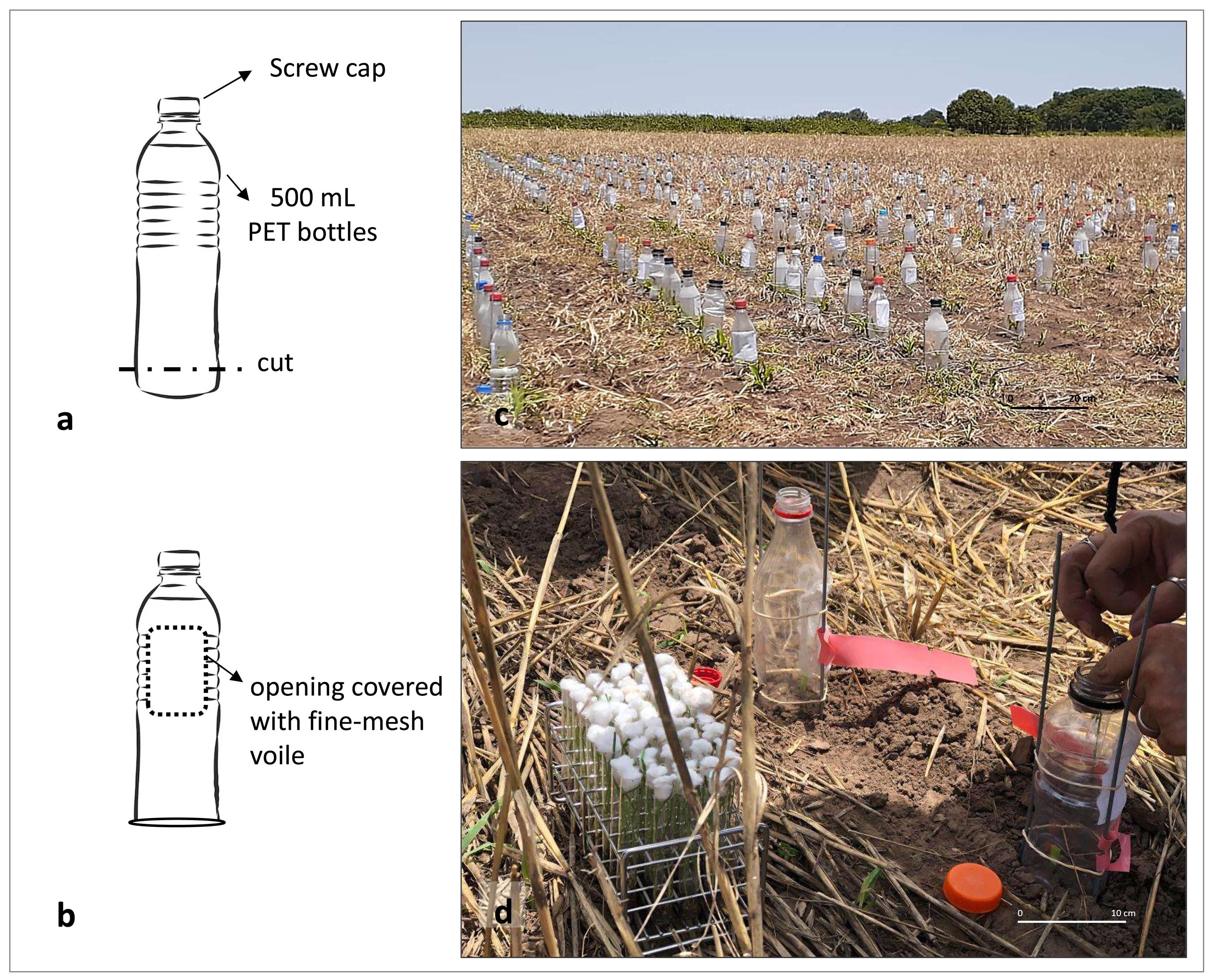
Figure 2. Field transmission of mal de Río Cuarto virus. (a, b) Schematic diagrams showing the fabrication of the transmission cages using 500 mL PET bottles. The design includes an opening covered with fine-mesh voile for ventilation. (c) Cages placed in the field over individual maize plants for controlled viral transmission. (d) Transfer of viruliferous insects from the glass tubes into the transmission cages. Note the use of two securing stakes (40 cm long × 2.5 mm Ø) and two elastic bands to ensure stability.
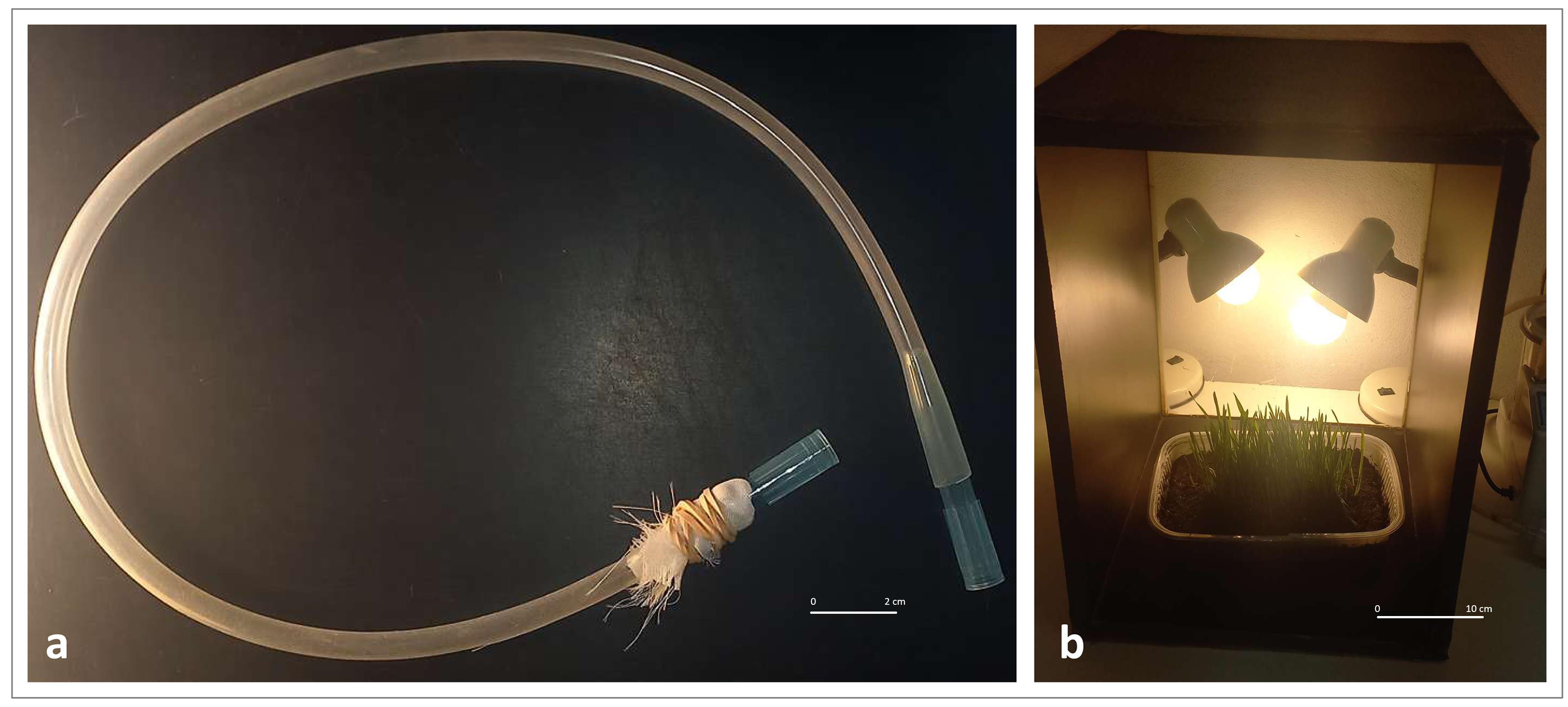
Figure 3. Materials for insect handling and light-assisted manipulation. (a) Mouth aspirator for D. kuscheli collection, showing the soft rubber tubing (40 cm long × 2.5 mm Ø), pipette tips, and a fine-mesh voile filter secured with an elastic band to prevent insect inhalation. (b) Insect manipulation chamber (black-painted wood) equipped with two LED lamps at the back. The light source facilitates the collection of insects by taking advantage of their positive phototaxis, directing them toward the back of the chamber for easier capture.
Software and datasets
1. Infostat (15) or similar platforms (e.g., Navure, https://www.navure.com/)
Procedure
文章信息
稿件历史记录
提交日期: Jan 5, 2026
接收日期: Feb 18, 2026
在线发布日期: Mar 4, 2026
出版日期: Mar 20, 2026
版权信息
© 2026 The Author(s); This is an open access article under the CC BY-NC license (https://creativecommons.org/licenses/by-nc/4.0/).
如何引用
Dumón, A. D., Barcenilla, M. R., Bariles, J. B., Pereyra, N. A., Rodriguez, S. M. and Mattio, M. F. (2026). Controlled Transmission of a Fijivirus Under Field Conditions Using Mass-Reared Planthoppers. Bio-protocol 16(6): e5642. DOI: 10.21769/BioProtoc.5642.

 Download Citation in RIS Format
分类
植物科学 > 植物免疫 > 病害生物测定
植物科学 > 植物免疫 > 植物-昆虫互作
微生物学 > 微生物-宿主相互作用 > 病毒
您对这篇实验方法有问题吗?
在此处发布您的问题,我们将邀请本文作者来回答。同时,我们会将您的问题发布到Bio-protocol Exchange,以便寻求社区成员的帮助。
 发布问题
发布问题


