
- Home
- Protocols

-


Leaf Rolling, Leaf Drying, and Drought Recovery Scores

Last updated date: Sep 1, 2026 Views: 31 Forks: 0

 Download PDF
 Ask a
question
Ask a
question
 How to
cite
How to
cite
 Favorite


Field scoring of rice leaf rolling, leaf drying and recovery under reproductive-stage drought
Method used in the rainout-shelter experiments reported by Ghneim-Herrera et al. (2017), with visual scores based on the IRRI Standard Evaluation System for Rice (SES).
Scope
This protocol describes the field procedure used to follow leaf rolling (LR), leaf drying (LD) and drought recovery (DRR) in rice exposed to water deficit at the reproductive stage. The observations are non-destructive and are made on intact plants. LR is followed during development of stress, LD is recorded at the drought endpoint, and recovery is scored after irrigation is restored.
In Trial 2 of the original study, drought was imposed at panicle initiation for 22 days. The final LR and LD values reported in Figure 3 correspond to peak stress at 22 days after stress initiation (22 DASI). All visual evaluations were made at noon.
Experimental setup
Trials 2 and 3 were carried out under rainout shelters at CIAT, Palmira, Colombia. For Trial 2, RN2, RN5 and RN6, their non-transgenic controls and WT Nipponbare were sown in a randomized complete block design with three replicates. Each plot contained six rows of 16 plants at 20 cm × 10 cm spacing; WT Nipponbare plants were interspersed for comparison. A duplicate irrigated experiment was maintained nearby.
For a new experiment, the essential requirement is that all genotypes being compared are established under the same agronomic conditions and reach panicle initiation under adequate irrigation before the drought treatment begins.
Materials and equipment
- For soil monitoring: Aquapro soil-moisture sensors or an equivalent calibrated system, with access tubes for measurements at several depths.
Optional physiological measurement: pressure chamber for predawn leaf water potential.
Drought imposition and monitoring
- Maintain plants under normal irrigation until panicle initiation.
- Suspend irrigation at panicle initiation and record this day as 0 DASI. Prevent rainfall from rewetting the plots.
- Follow soil drying throughout the treatment. In the original experiment, soil moisture was measured at 20, 40, 60 and 80 cm and converted to soil matric potential using soil-specific water retention curves.
- Follow LR at regular intervals during the stress period, always at the same time of day. In the original study, scoring was performed at noon.
- Continue the treatment until the predetermined severe-stress endpoint. In Trial 2 this endpoint occurred at 22 DASI, immediately before irrigation was restored.
- After the final LR and LD observations, irrigate the plots fully and resume normal irrigation during recovery.
Reference water status in Trial 2. At 20 cm depth, soil matric potential fell below the conventional permanent wilting point (approximately -1.6 MPa) by 10 DASI and became very low thereafter. At 40 cm depth, soil matric potential reached approximately -0.6 MPa by day 20. The treatment was maintained until day 22. These values describe the original Palmira soil and should not be used as universal thresholds for other soils.
Leaf rolling
LR is scored visually on the whole plant. Leaves are not detached. Observe the general degree of folding or rolling and assign the closest SES category. Use the same observer whenever possible and keep the scoring time constant because rolling changes rapidly with plant water status and atmospheric demand.
| Score | SES description |
|---|---|
| 0 | Leaves healthy and unrolled. |
| 1 | Leaves start to fold; shallow folding. |
| 3 | Leaves folding; deep V-shape. |
| 5 | Leaves fully cupped; U-shape. |
| 7 | Leaf margins touching; O-shaped cross-section. |
| 9 | Leaves tightly rolled. |
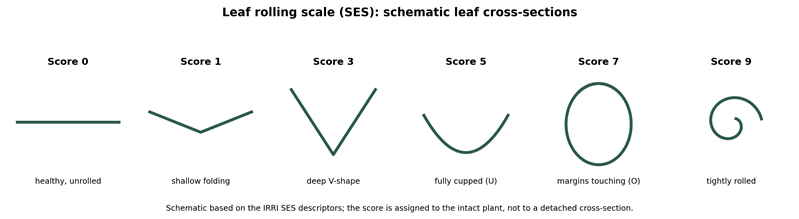
Figure 1. Schematic visual guide to the SES leaf-rolling categories. The diagrams represent leaf cross-section only as an aid to scoring; the experimental score is assigned to the intact plant.
Leaf drying
LD is evaluated at peak stress, on the same intact plants and at noon. In Trial 2 this corresponded to 22 DASI, immediately before rewatering. Assign the closest SES category:
| Score | SES description |
|---|---|
| 0 | No symptoms. |
| 1 | Slight tip drying. |
| 3 | Tip drying extends to approximately one-quarter of leaf length in most leaves. |
| 5 | Approximately one-quarter to one-half of all leaves are dried. |
| 7 | More than two-thirds of all leaves are fully dried. |
| 9 | All plants were apparently dead. |
Recovery after rewatering
Restore full irrigation immediately after the peak-stress observations. Ten days after rewatering, determine the proportion of plants that recovered and convert the percentage to the SES drought-recovery score:
| DRR score | Plants recovered |
|---|---|
| 1 | 90–100% |
| 3 | 70–89% |
| 5 | 40–69% |
| 7 | 20–39% |
| 9 | 0–19% |
In Trial 2, RN5 and RN6 had a mean DRR score of 1.7, compared with 3.0 for WT Nipponbare.
Optional measurement of plant water status
Predawn leaf water potential can be measured on fully expanded flag leaves with a pressure chamber.
Field record
For each plot or experimental unit, record genotype, replicate, date of stress initiation, DASI, time of scoring, LR score, LD score at peak stress, date of rewatering, number of plants evaluated, percentage recovery and DRR score. When available, add soil matric potential together with measurement depth and predawn leaf water potential.
Using the method in other environments
The 22-day duration observed in Palmira is not a fixed biological requirement. The rate of soil drying depends on soil texture, rooting depth and atmospheric demand. For comparative screening, the endpoint should therefore be defined from the combination of elapsed time, soil water status and the response of a susceptible reference genotype. In the original Trial 2, the reported endpoint combined 22 DASI, severe drying of the upper soil profile, approximately -0.6 MPa at 40 cm by day 20, and a mean LR score of 5.5 in WT Nipponbare.
References
Ghneim-Herrera T, Selvaraj MG, Meynard D, Fabre D, Peña A, Ben Romdhane W, Ben Saad R, Ogawa S, Rebolledo MC, Ishitani M, Tohme J, Al-Doss A, Guiderdoni E, Hassairi A. (2017). Expression of the Aeluropus littoralis AlSAP Gene Enhances Rice Yield under Field Drought at the Reproductive Stage. Frontiers in Plant Science 8:994. doi:10.3389/fpls.2017.00994.
International Rice Research Institute (IRRI). (2013). Standard Evaluation System for Rice, 5th edition. Los Baños, Philippines: IRRI/INGER.
- Ghneim, T, Selvaraj, M and Ghneim, T(2026). Leaf Rolling, Leaf Drying, and Drought Recovery Scores. Bio-protocol Preprint. bio-protocol.org/prep2990.
- Ghneim-Herrera, T., Selvaraj, M. G., Meynard, D., Fabre, D., Peña, A., Romdhane, W. B., Saad, R. B., Ogawa, S., Rebolledo, M. C., Ishitani, M., Tohme, J., Al-Doss, A., Guiderdoni, E. and Hassairi, A.(2017). Expression of the Aeluropus littoralis AlSAP Gene Enhances Rice Yield under Field Drought at the Reproductive Stage. Frontiers in Plant Science 8. DOI: 10.3389/fpls.2017.00994
Do you have any questions about this protocol?
Post your question to gather feedback from the community. We will also invite the authors of this article to respond.
 Post a Question


