
- Home
- Protocols

-


Lab protocol to quantify siRNA strands via stem loop qPCR

Last updated date: Aug 31, 2026 Views: 41 Forks: 0

 Download PDF
 Ask a
question
Ask a
question
 How to
cite
How to
cite
 Favorite


Declaimer: The protocol has been optimized to work with snap frozen or RNAlater preserved liver and kidney samples from unchallenged C57BL/6 mice. However, this protocol can be used as a starting point to expand to other tissues.
Material used:
- Lysis buffer (QuantiGene, QuantiGene™ Sample Processing Kit, tissues (Cat. No. QS0106, Lot: 378856-000)
- + Proteinase K (50µg/µl, from QuantiGene Kit above)
- Tissue Lyser (Retch Type MM300)
- Tungsten Carbide Beads (Qiagen Ref: 69997; Qiagen, Venlo, Netherlands))
2 ml PCR-clean centrifugation tubes (Sarstedt, Cat. 72695400)
Preparation of tissue lysates:
Weigh in organ sample of around ~30 mg (at least 20 mg)/tube, note down weight for lysis buffer volume adjustment, work at -80°C via precooling cutting plate and on dry ice if snap frozen tissues are used, otherwise at RT for RNAlater samples.
Prepare QuantiGene lysis buffer at RT: 1:100 dilution of lysis buffer with proteinase K.
E.g., 30690 μL homogenizing solution + 310 μL proteinase K.
Quickly pipette the appropriate volume of lysis buffer to the tissue at RT
7.5 µL lysis buffer/1 mg tissue. (can be adjusted to 15µl/mg)
- Add one Tungsten Carbide Bead/tube
- Shred tissue 5x30s at 27.5Hz (after second C fourth time -> centrifuge tubes briefly) at RT
- Ultimately, centrifuge tubes briefly.
- Incubate lysate for 30 min at 65°C (vortex briefly every 10 min).
- After 30 minutes centrifuge for 10 min at RT at 16,000 rpm (21,000 × g).
- Split the supernatant: 1x 60 µL C 1x remaining volume (~120 µl) into a 96-well plate. Be sure to avoid pallet contamination for either sample.
Checkpoint: Either proceed immediately with the stem loop assay or store at -80 to -20°C.
Preparation of stem loop primer (SL) for reverse transcriptase:
Note: Primers were previously heated in previous experiments and can be stored at -20°C!
- Dissolve SL Primer in Ultra-pure water and prepare 100µM stock solution
- SL-Primer (AT3): GTCGTATCCAGTGCAGGGTCCGAGGTATTCGCACTGGATACGACTTAACA
Re-/Fold primer by transferring 50 µl to a new tube and heat in a PCR thermocycler. Use the following heating steps:
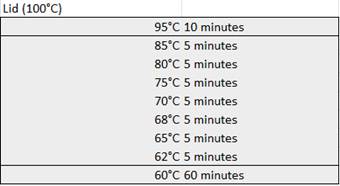
- Dilute heated SL Primer 100 µM (100,000 nM) to 250 nM =1:400
- SL Primer [µl] 10
- Nuclease-free H2O [µl] 3990
Total volume [µl] 4000
Prepare standard series for reverse transcriptase:
- It is recommended to use the same siRNA conjugate batch as administered in the animal experiment.
- Also, it is recommended that when generating data for different molecular designs, each siRNA conjugate has its own standard series and quality control (QC).
- Untreated animal samples or vehicle control animals (e.g., liver lysate from a PBS-treated animal) are used as a matrix for the standard and QC
Use water for molecular biology not DEPC treated water (e.g., TH. GEYER, Cat:7711-500ml)
Pipetting execution:
- Matrix is prepared from the current experiment of PBS animals
- The dilution of the matrix in the standard curve depends on the samples we want to quantify
- The standard and sample must be diluted to the same dilution level
Diluting animal samples:
Pipette each point 3 times to achieve “true triplicates!”

Then dilute the untreated or PBS lysate in ultra-pure water, which will be the matrix
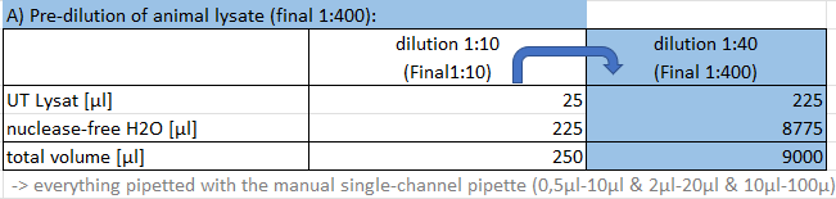
Standard series siRNA conjugates: For all siRNAs:
- Thaw 20 µM stock
- Dilute 20 µM stock to 5 µM (12.5 µl 20 µM + 37.5 µl ultra-pure H2O)
- Dilute 5 µM stock to 0,5 µM (10.0 µl 20 µM + 90.0 µl ultra-pure H2O)
→siRNA Stock (Stock 500 nM)
Everything is pipetted with a single channel pipette (2µl-20µl C 10µl-100µl)
B) Pre-dilute siRNA conjugate (heated stock) for the standard series, which equals 10x concentration of the starting concentration of the standard row.
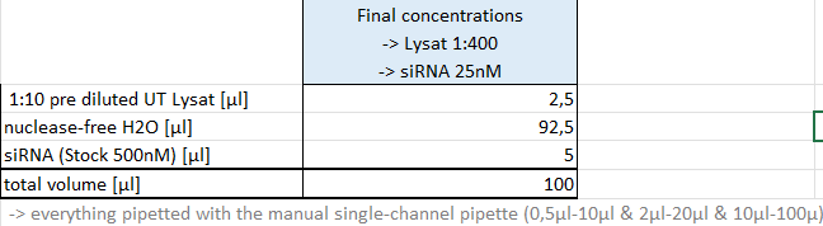
Pipette standard series for each siRNA, lysate 1:400 (serial dilution):
→Pipette each point 3 times to achieve “true triplicates!”
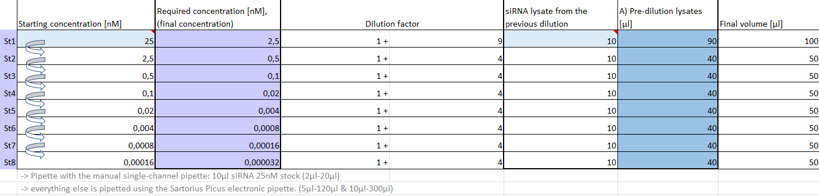
Quality controls for each siRNA pipette, lysate 1:400 (serial dilution):
Pipette each point 3 times to achieve “true triplicates!”
 → everything else is pipetted using the Sartorius Picus electronic pipette. (5µl-120µl C 10µl-300µl)
- Pipette 4 µl of pre-diluted sample (2.), standard (3.), or QC (4.) into a LoBind PCR plate (Eppendorf twin.tec®-PCR-Platte 96 LoBind, skirted, 150 µL, PCR clean, colorless (Eppendorf AG, Cat: 0030129512)
Melt the duplexes by heating the plate in a PCR cycler for 10 min at 95°C,
Then place immediately on ice (Reason: This will avoid rehybridization of the single strands)
Then centrifuge briefly to collect condensation.
Reverse transcriptase reaction:
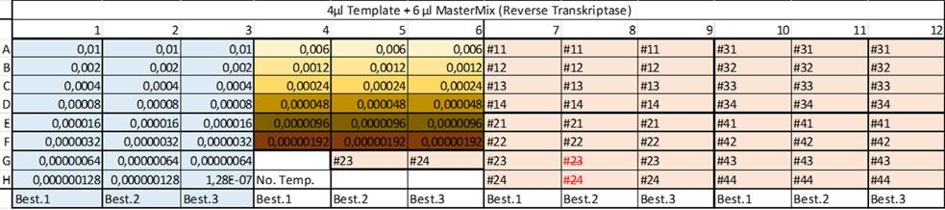
Example plate layout:
Example master mix preparation for 96 samples:
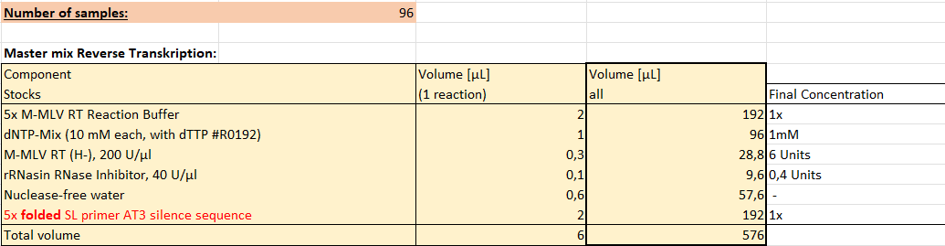
→Pipette 6 µl RT master mix into the pre-diluted C heated samples or standards and centrifuge briefly
→Final Volumes: 4 µL template (siRNA/A strand) + 6 µL revTrans Master mix
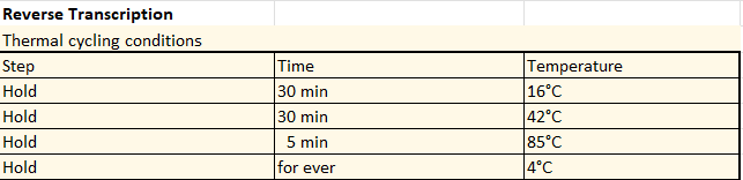
Checkpoint opportunity: Pipette immediately into a qPCR with the transcript or freeze at -20 °C! Overnight storage in the thermocycler at 4°C is also acceptable!
qPCR reaction:
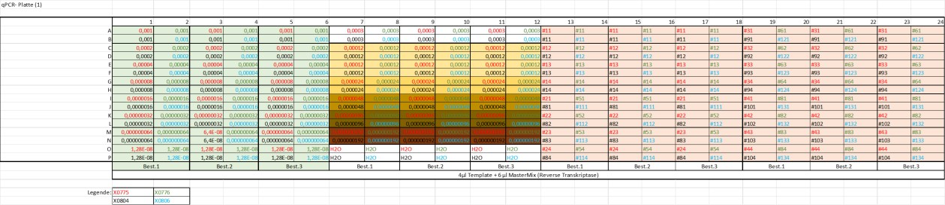
Example plate layout:
- Dilute sample:
- Transfer 20 µl nuclease-free water to new 384-well plate and add 5 µL of RT-product reverse-transcribed sample.
- Mix by pipetting up and down
- Transfer 5 μL of this diluted sample into PCR reaction plate. Add 15 µl of the PCR master mix per 20-μL PCR reaction into the wells
- Solve Upper, Lower C Probe Primer in ultra-pure water and vortex
- Store at -20°C)
Prepare Master Mix for qPCR:
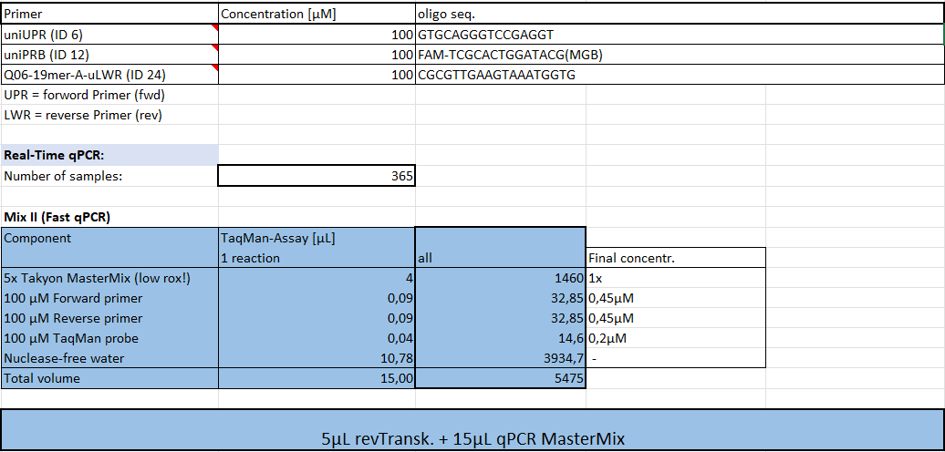
Pipette 5 µL diluted revTransc. and 15 µL qPCR MasterMix into a MicroAmp Fast 384- well reaction plate

Calculations of standard and QC:
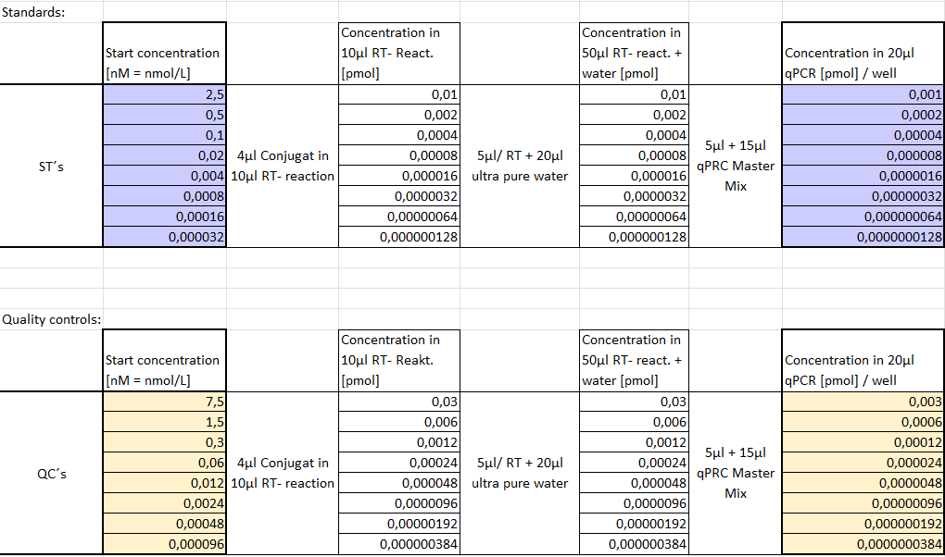
To calculate the concentration of the unknown samples, use a 5-parameter non-linear fit. We used an Asymmetric Sigmoidal, 5PL where X is log(concentration). Calculations are done in GraphPad Prism.
Related files
 Lab-Protocol to quantify siRNA strands via stem loop qPCR..pdf
- Rathjen, S J, Morrison, E and Wikström Lindholm, M(2026). Lab protocol to quantify siRNA strands via stem loop qPCR. Bio-protocol Preprint. bio-protocol.org/prep2988.
- Schöllkopf, S., Rathjen, S., Graglia, M., Was, N., Morrison, E., Weingärtner, A., Bethge, L., Hauptmann, J. and Lindholm, M. W.(2024). The beauty of symmetry: siRNA phosphorodithioate modifications reduce stereocomplexity, ease analysis, and can improve in vivo potency. Molecular Therapy. Nucleic Acids 35(4). DOI: 10.1016/j.omtn.2024.102336
Do you have any questions about this protocol?
Post your question to gather feedback from the community. We will also invite the authors of this article to respond.
 Post a Question


