
- Home
- Protocols

-


A SIMPLE AND REPRODUCIBLE METHOD FOR EXTRACTION OF VIABLE SEEDS FROM RIPE TOMATO FRUITS

Last updated date: Jul 15, 2026 DOI: 10.21769/p2969 Views: 155 Forks: 0
 Download PDF
 Ask a
question
Ask a
question
 How to
cite
How to
cite
 Favorite


A SIMPLE AND REPRODUCIBLE METHOD FOR EXTRACTION OF VIABLE SEEDS FROM RIPE TOMATO FRUITS
Anjan Barman*
Department of Biotechnology
Pandu College, Maligaon, Guwahati-12, Assam, India
*Address for Correspondence: E-mail: anjbth@gmail.com
ABSTRACT:
Tomato seeds are harvested from mature and ripe fruits that involve extraction and separation of seeds from plant materials. Mechanical and chemical methods for separation of tomato seeds from plant materials are in regular practice. Here, a very simple approach for extraction/separation of seeds from ripe tomato fruits is forwarded. This protocol is easily reproducible and effective for tomato seed harvesting at small scale, especially for laboratory studies. Further, seeds obtained through this methodology can be stored for longer periods following already established practices.
KEY WORDS: Tomato fruit; Tomato seed extraction; Manual method
KEY FEATURES:
Simple, economical and reproducible method for tomato seed extraction
No requirement of sophisticated instruments
Useful for small scale laboratory research and agronomic practices
An eco-friendly approach that do not involve use of any hazardous chemicals
INTRODUCTION
Tomato seeds are essential commodity for maintenance of tomato germplasm for future utility. Seeds act as starting material for continuation of tomato breeding and agronomic value additions [Hilhorst et al., 1998; Khan et al., 2012]. Besides, several other uses of tomato seeds are documented [Kiralan & Ketenoglu, 2022; Firrman et al., 2024]. In many scientific experiments, tomato seeds are germinated to obtain seedling stages which can then be readily utilized or further propagated for specific experimental goals [Arie et al., 2007; Kumar et al., 2016]. Good quality tomato seeds are henceforth crucial for all kinds of downstream utilities.
Different approaches (e.g., manual, fermentation or chemical treatment) are followed for extraction of seeds from mature, ripe tomato fruits [Raval et al., 2016; Pozhilarasi et al., 2022; Degwale et al., 2023]. Initial step in all of these methods, is common- separation of juicy soup containing the seeds from the cut open ripe tomato fruits. The ‘juicy soup’ (containing tomato seeds) is then treated in different manner. In manual approach, a sieve is used to wash off plant matter from seeds. Fermentation method involves incubation of the above juice for few days with addition of water. The chemical method of extraction may include acid/alkali treatment of the above juice for specific time periods. Among all, manual method of extraction is simple and do not require fermentation or chemical treatment steps. However, seed extracted via manual approach has been reported to decrease certain physiological traits quantitatively as compared to other two methods [Raval et al., 2016; Pozhilarasi et al., 2022; Degwale et al., 2023]. Despite this, manual method of extraction is uncomplicated and can be performed without any sophistication. Further, this method avoids use of toxic chemicals or fermentation steps that can be followed by anyone with minimum laboratory skills. In addition, tomato seed extraction through manual approach can be economically viable for small scale laboratory experimental goals.
Herein, a simple, economical and reproducible protocol for seed extraction from ripe tomato fruits has been elaborated as under.
MATERIAL REQUIREMENTS
Ripe tomato fruits
Knife
A kitchen sieve of wider size
A stainless steel bowl (where the kitchen sieve would fit into and can be placed over)
Clean tap water
Sheets of white paper
A tooth-pick
Container for storing the extracted seeds
MAIN STEPS OF THE PROTOCOL
1.Take fully ripe tomato fruits for seed harvest.
Fully ripe tomatoes directly plucked from plant contain mature and quality seeds in terms of size and viability.
2. Clean the tomato surfaces properly with tap water.
Cleaning the surface would avoid contamination from external impurities.
3. Next, with a cleaned knife cut the fruit into pieces as found convenient for drawing out seeds from the fruit.
Inside, tomato seeds usually remain enclosed in specialized compartments called locules which are attached to placental wall. Seeds in locules remain immersed in gelatinous, slippery substances that also protect them. In order to obtain viable seeds, these gelatinous constituents along with placental residues require to be eliminated.
4. Carefully draw out the seeds that usually accompany mucilages alongside some parts of placental tissues and put this mixture in a kitchen sieve that is placed over a stainless steel bowl beforehand.
A sieve of a bit wider size can help in the cleaning process efficiently. Sieve pore size should be adequate to retain tomato seeds while filtering out unnecessary constituents during washing.
5. Add sufficient tap water to the sieve so as to immerse the tomato seed enmeshed in mucilage and placental tissues. Gently squeeze the viscous mass under water to dislodge the seeds from rest of the constituents.
This would gradually separate the seeds from mucilages and other tissue contents.
6. Next, gently press the seeds against the walls of the sieve. Repeat this procedure 3-4 times for washing the seeds to get rid of maximum impurities from the seeds.
This helps gradual removal of the mucilaginous coat attached to seeds. Mucilages start to float in water. Also, immature seeds that are greenish to white in color and are smaller in size begin to float over water. These can be removed by draining the water from the sieve. Mature seeds generally settle to the bottom of the sieve as may be noticed.
7. After draining away water from the sieve, allow wet seeds to stand on the sieve for an hour at least.
To an extent, this step would further deplete water content in the seeds.
8. Next, arrange few sheets of clean white paper (commonly used in academic/official purposes), and unfold them on the floor.
9. Now, start spreading the cleaned seeds kept in the sieve over the white sheets of paper. A toothpick can be handy while spreading the seeds in a manner that each seed is split from one another and ensure there is no overlapping of the seeds. This step would ensure collection of individual tomato seeds from the paper sheets.
10. Once the seeds have been completely dispensed over the white sheets of paper one by one, incubate the sheets of paper (with seeds spread on top side) at room temperature for 24-48 hrs. Direct exposure of the seeds on paper to sunlight must be avoided to minimize loss of threshold moisture content in seeds.
11. After 24-48 hrs, carefully detach the seeds attached to white sheets of paper individually using a toothpick.
12. Next, store the seeds in air tight containers at room temperature, avoiding exposure to direct sunlight for subsequent use.
Small plastic/glass containers with closing lids can be used to store the seeds safe. Seeds stored at cooler temperature, low humid and dark conditions have been suggested to increase storage duration.
13. Seeds extracted and stored as above can remain viable for germination for eight (8) months to a year. However, viable germination period might vary with respect to tomato cultivar and storage conditions.
14. In case of this protocol, developed at Guwahati (Assam, India), the mean monthly temperature during the period (i.e. March, 2025 to May, 2026) ranged between 18°C and 30°C [data retrieved from https://weatherandclimate.info]. In the experimental period, the viability of stored tomato seeds post-harvest could be observed to be between 8 months to 1 year. Viability of seeds was observed in terms of germination potential of the seeds and other parameters were not tested.
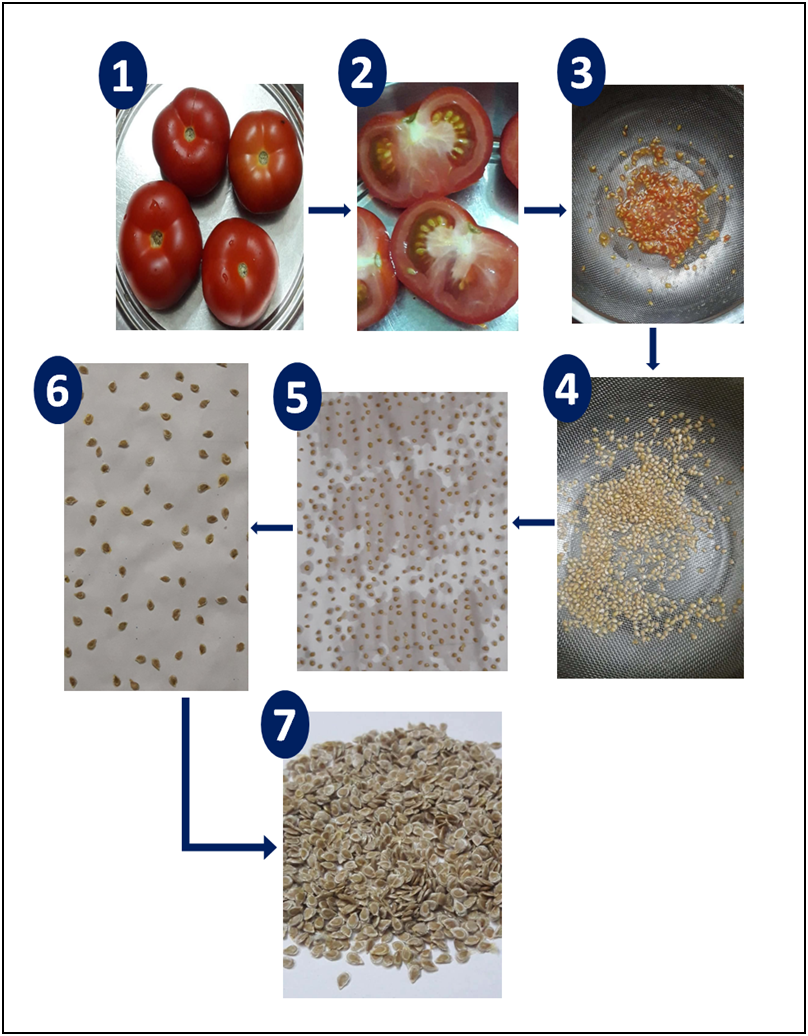
FIGURE 1: Illustration of the key steps followed (1à6) during extraction of seeds from ripe tomato fruits. Detailed steps are cited in the protocol section of the text. Step 1- Ripe tomato fruits of Arka Vikas cultivar (seed source: IIHR, Bangalore, India). Step 2- tomato fruits cut open with a cleaned knife. Step 3- tomato seeds contained in juicy soup (comprising mucilage, tissue materials etc.) transferred to a kitchen sieve. Step 4- seeds after performing 3-4 times of washing in tap water. Step 5- washed seeds from previous step, spread over white paper sheets. Step 6- dried tomato seeds on the white paper sheet after 48 hours of incubation at room temperature. Step 7- collected dried seeds detached from the sheets of white paper using a tooth-pick. Seeds obtained at step 7 are then stored in air-tight containers for subsequent use.
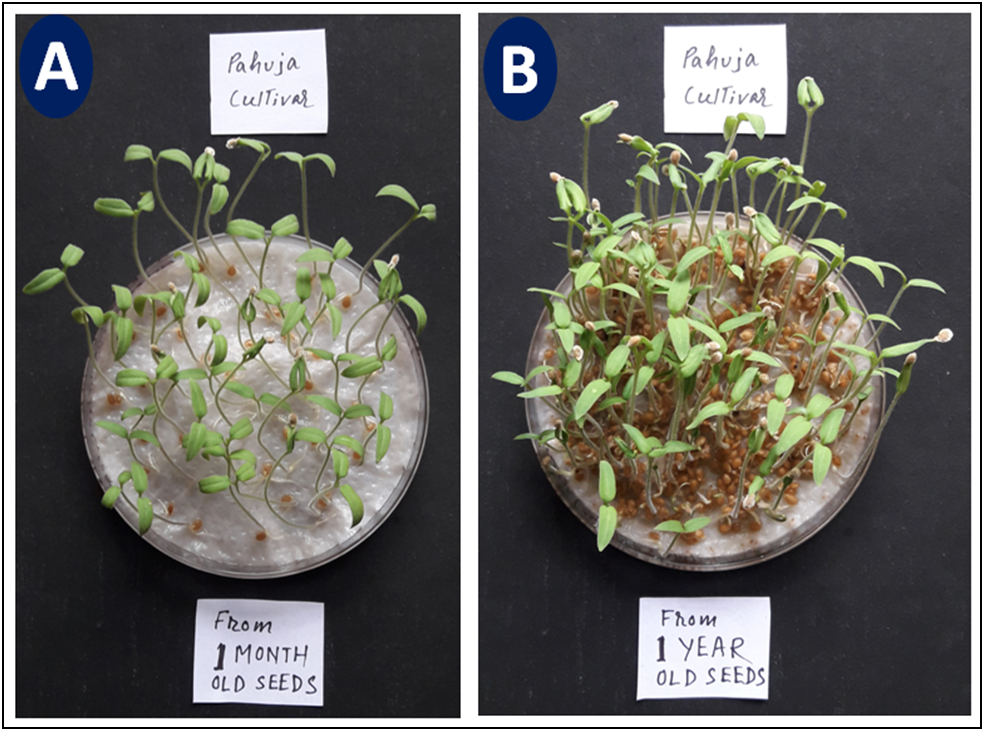
FIGURE 2: Illustration of the seed germination experiment for seeds derived from Pusa Ruby (Pahuja) tomato cultivar. Seeds were extracted from the mature ripe fruits of the same cultivar by following the protocol described above. Seed germination shown here is after 12th day period of the experiment. (A) Germinated seeds after one month (1 month) period of extraction from mature ripe fruits. (B) Germinated seeds after one year (1 year) period of extraction from mature ripe fruits. This indicates seeds extracted via the protocol discussed here retain viability and vigor up to one year (1 year) duration. However, this may be variable for different cultivars and would subject to storage conditions.
PRECAUTIONS
Unhealthy ripe tomato fruits which could be infested with pests or pathogens should be avoided for seed extraction.
Clean tap water should be used for seed extraction to eliminate contamination of seeds with detrimental microbes
Proper removal of mucilages from seeds is recommended to avoid microbial growth in seeds. Mucilages are rich sources of polysaccharides and attract varied microbes.
Immature greenish/white color seeds should be eliminated during washing process.
Proper drying of seeds on top of the white paper sheets at room temperature is advised. Seeds improperly dried have higher chances of contamination with microbes. Further, wet seeds may start to sprout early and cause hindrance in storage.
For seed drying, tissue paper or blotting paper should be avoided. Use of these papers may cause difficulty in removing the dried seeds. Seeds may come out with damaged cellulose fibers attached to seed coats.
Seed drying in direct sunlight should be avoided. This is to help retain minimum threshold moisture within seeds.
Seeds stored in air tight containers can be safely protected from pests.
ACKNOWLEDGEMENT
Author (AB) would like to acknowledge his family members (especially his parents) for their constant support during the course of the experimental work detailed in this report.
DECLARATION
No conflict of interest exists with any individual relating to publication of this report
SELECTED REFERENCES
1] Arie, T., Takahashi, H., Kodama, M., Teraoka, T. (2007). Tomato as a model plant for plant-pathogen interactions. Plant Biotechnology, 24(1), 135-147. DOI: https://doi.org/10.5511/plantbiotechnology.24.135
2] Degwale, A., Tesfa, T., Meseret, B., Fantaw, S. (2023). Seed extraction methods affect the physiological quality of tomato seed and developing seedlings. International Journal of Vegetable Science, 29(1), 16-24. DOI: https://doi.org/10.1080/19315260.2022.2083042
3] Firrman, J., Narrowe, A., Liu, L., Mahalak, K., Lemons, J., Van den Abbeele, P., et al. (2024). Tomato seed extract promotes health of the gut microbiota and demonstrates a potential new way to valorize tomato waste. PloS ONE, 19(4), e0301381. DOI: https://doi.org/10.1371/journal.pone.0301381
4] Khan, N., Kazmi, R.H., Willems, L.A.J., van Heusden, A.W., Ligterink, W., Hilhorst, H.W.M. (2012). Exploring the natural variation for seedling traits and their link with seed dimensions in tomato. PLoS ONE, 7(8): e43991. DOI: https://doi.org/10.1371/journal.pone.0043991
5] Kiralan, M., Ketenoglu, O. (2022). Utilization of tomato (Solanum lycopersicum) by-products: an overview. In: Ramadan, M.F., Farag, M.A. (eds) Mediterranean Fruits Bio-wastes. Springer, Cham. DOI: https://doi.org/10.1007/978-3-030-84436-3_34
6] Kumar, R., Barman, A., Phukan, T., Kabyashree, K., Singh, N., Jha, G., et al. (2017). Ralstonia solanacearum virulence in tomato seedlings inoculated by leaf clipping. Plant Pathology, 66(5), 835-841. DOI: https://doi.org/10.1111/ppa.12628
7] Pozhilarasi, S. R., Ranjith, S., Samuel, R., Gracy, P. (2022). Effects of different seed extraction methods on seed quality parameters in tomato var pkm. 1. International Journal of Current Microbiology and Applied Sciences, 11(1), 199-204. DOI: https://doi.org/10.20546/ijcmas.2022.1101.023
8] Raval, A., Sasidharan, N., Rao, K., (2016). Effect of seed extraction procedures on seed quality parameters in tomato. Advances in Life Sciences, 5(20), 9020-9024.
9] Hilhorst, W. M. H., Groot, P.C., S., J Bino, R. (1998). The tomato seed as a model system to study seed development and germination. Acta Botanica Neerlandica, 47(2), 169-183.
- Barman, A(2026). A SIMPLE AND REPRODUCIBLE METHOD FOR EXTRACTION OF VIABLE SEEDS FROM RIPE TOMATO FRUITS. Bio-protocol Preprint. 10.21769/p2969.
Do you have any questions about this protocol?
Post your question to gather feedback from the community. We will also invite the authors of this article to respond.
 Post a Question


